


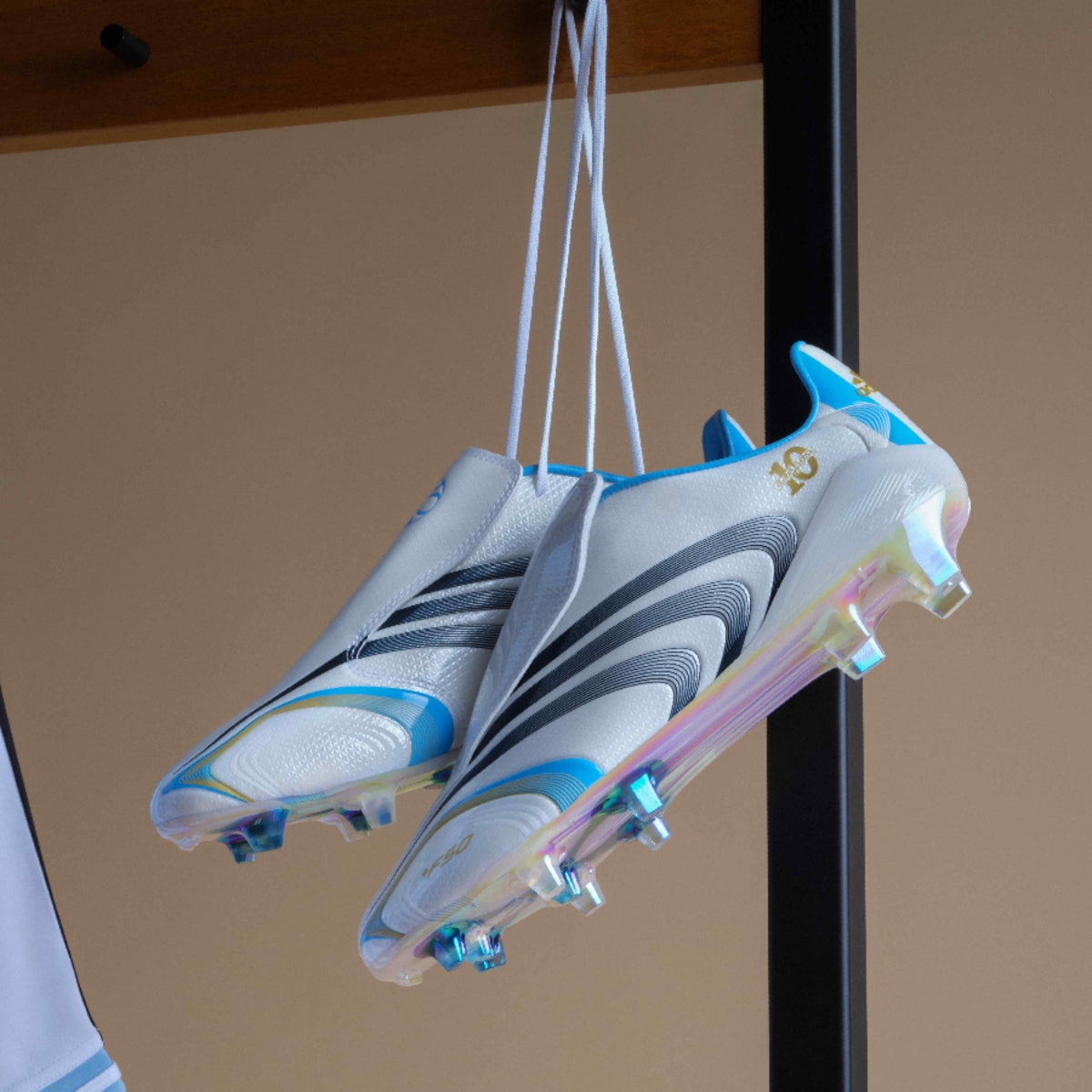
How should soccer cleats fit?
If you are wearing your soccer cleats with the same "roomy" fit as your sneakers, you are losing power, speed, accuracy, and giving the opponent an advantage.
To play like a Pelé, you have to lace up in the right boots for you. This is the definitive guide to the locked-in fit.
1. The Anatomy of the 1:1 Fit
Most players make the mistake of leaving a thumb’s width of space at the toe. This is a costly mistake.
-
The Lockdown: Your heel should be locked into the back of the boot like a secondary skin. If there is a 2mm gap, your foot will slide during an explosive sprint, leading to friction, blisters, and wasted energy.
-
The Toe Box: Your toes should be as close to the front of the boot as possible without being painfully curled. You want the ball to feel like it’s hitting your foot, not a layer of air and material.
-
The Squeeze: A new boot should feel "snug"—bordering on tight.
2. Materials: Know Your Weapon
Your choice of material dictates how the boot will evolve. You don't buy for how it feels today; you buy for how it will perform in the 90th minute.
The Legend: K-Leather & Premium Leather
Leather is the only material that learns your foot. It is organic and adaptive.
-
The Strategy: Buy these tight. Leather will stretch 5% to 10% as it breaks in. If they aren’t slightly "uncomfortable" on day one, they will be too loose by day thirty.
-
The Reward: A personalized, molded fit that offers the dampened, "maestro" touch popularized by the King himself.
The Future: Synthetics & Knits
Engineered for the speed-demon, these materials are about 1:1 energy return.
-
The Strategy: What you feel is what you get. These will not stretch. If they pinch your foot uncomfortably now, they will pinch it forever.
-
The Reward: Lightweight, weather-resistant, and zero water absorption. Perfect for the player whose game is built on pure velocity.
3. Surface Geometry: Non-Negotiable Traction
Playing with the wrong stud pattern isn't just a preference—it’s a liability.
| Surface | Cleat Type | Why It Matters |
| Natural Grass | FG (Firm Ground) | Blades or studs designed to penetrate the soil for maximum torque. |
| Artificial Turf | AG (Artificial Grass) | Shorter, hollow studs. Crucial: Using FG on Turf is the #1 cause of non-contact knee injuries. |
| Wet/Muddy Pitch | SG (Soft Ground) | Long, metal-tipped studs. If you aren't slipping, you're winning. |
4. How to Measure Like a Pro
Don't rely on your "sneaker size." Sizes vary between brands like Nike, adidas, and PUMA.
-
Measure in Millimeters: This is the only objective measurement in footwear.
-
Wear Your Socks: Never try on boots with bare feet or street socks. The thickness of your match-day sock changes the internal volume.
-
The Stand Test: Put the boots on and stand up. Your feet expand under your body weight. If they feel "tight" while sitting but "perfect" while standing, you’ve found the King’s Standard.
The Pelé Verdict
If your boot moves independently of your foot, you are playing at a disadvantage. Demand a fit that is clinical, a material that suits your touch, and a soleplate built for your foot.
Read more
Every weekend, the group chat explodes. Someone drops a clip of Messi or CR7, and suddenly everyone’s arguing about the "Greatest of All Time." At Pelé Soccer, we live and breathe this game. We lov...
Every weekend, the group chat explodes. Someone drops a clip of Messi or CR7, and suddenly everyone’s arguing about the "Greatest of All Time." At Pelé Soccer, we live and breathe this game. We lov...



Leave a comment
All comments are moderated before being published.
This site is protected by hCaptcha and the hCaptcha Privacy Policy and Terms of Service apply.